
Table of Contents
Exploring Colorado Construction License Classes
Determining the right Colorado Construction License Class is a critical first step when building a contracting business in our state. Within Colorado Contractor Licensing Requirements, licenses are typically divided into distinct categories that reflect the scope, cost, and complexity of projects a contractor is authorized to handle. We find that understanding these licensing tiers early on saves time and keeps your business compliant from the start.
A Residential Contractor License generally covers projects involving single-family homes and smaller multi-family dwellings, often with project cost thresholds that distinguish it from higher classes. In contrast, a Commercial Contractor License applies to work on larger-scale structures such as office buildings, retail centers, and industrial facilities, where more stringent experience and competency standards are required. The General Contractor License represents the broadest scope, allowing a contractor to manage an entire project across multiple trades and typically carrying higher bonding or insurance requirements. Obtaining a specific license class directly affects a contractor’s authority to pull permits and bid on both public and private work, so aligning your business model with the correct category is essential.
Many of the higher license classes, including Commercial and General categories, require passing the ICC National Standard Contractor Exam to verify competency across multiple trade disciplines. The National Association of Home Builders notes that such exam frameworks are widely used to establish professional benchmarks, and AGC Colorado provides local insight into how these license class definitions are applied throughout our region. After identifying the appropriate license class, many contractors choose to enroll in a contractor certification course to prepare for the required exams. Selecting the right class is the first step toward meeting exam and bonding requirements, and in our community, For Contractors, by Contractors, we are ready to help you navigate that path.
Class A, B, C, and State-Level Requirements
Now that you understand the licensing landscape, let’s examine the Colorado Construction License Class system in detail. Colorado does not issue a single statewide contractor license; instead, municipalities administer licensing locally. However, most jurisdictions recognize a common three-tier framework of contractor license classes to categorize professionals by their project scope and qualifications.
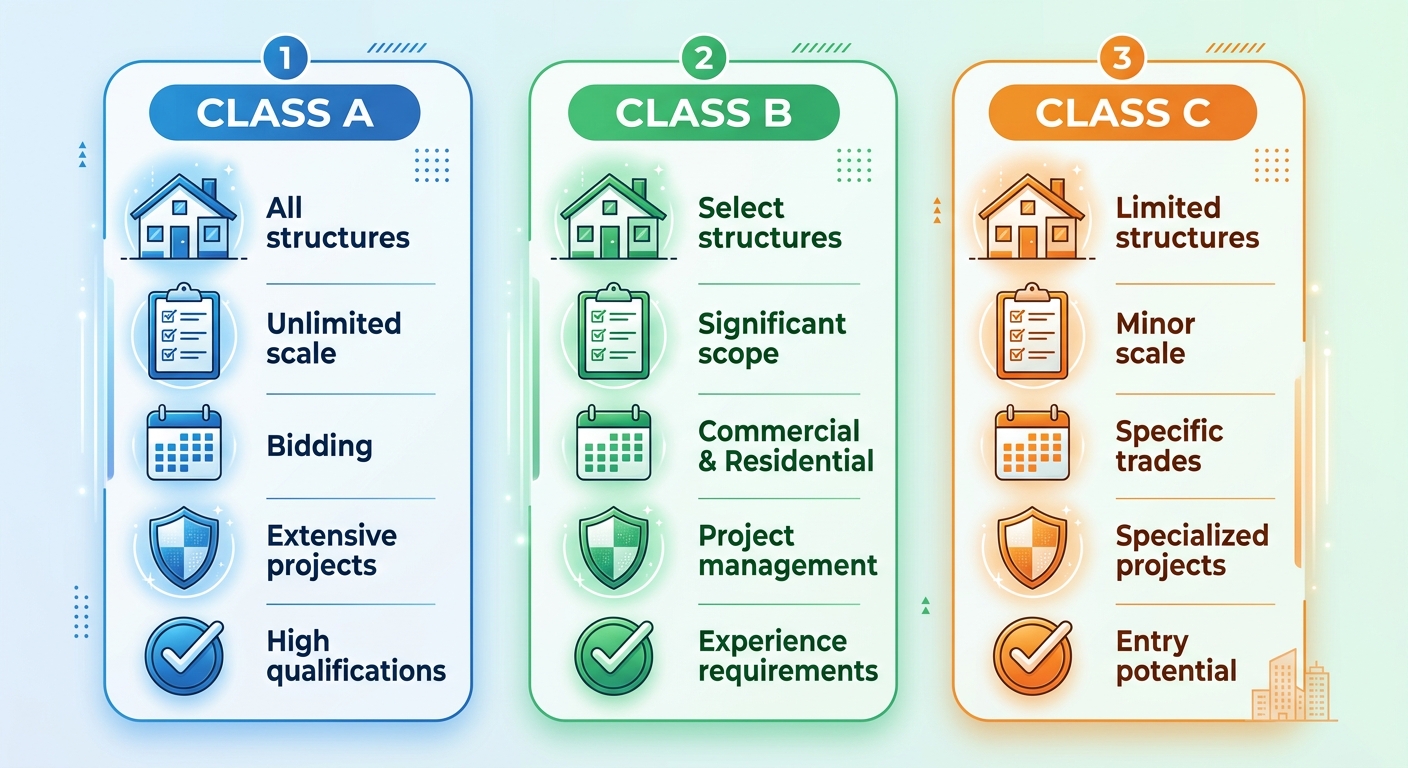
Colorado contractor license class comparison infographic with icons and labels.
The comparison table below outlines the core differences between these three tiers. These classifications help homeowners and contractors alike understand which license category fits a given project, from small residential repairs to unlimited commercial construction.
| License Class | Scope of Work | Required Exam | Minimum Experience | Typical Insurance Limits | Bond Requirement |
|---|---|---|---|---|---|
| Class A | Unlimited residential and commercial construction | ICC G11 (General Building Contractor) | 4+ years (varies by municipality) | $1M general liability | $25,000-$50,000 surety bond |
| Class B | Medium-scale residential and light commercial | ICC G12 (Residential Building Contractor) | 2-3 years | $500K-$1M general liability | $15,000-$25,000 surety bond |
| Class C | Small residential projects up to $50,000 | ICC G13 (Residential Limited) or local equivalent | 1-2 years | $300K-$500K general liability | $5,000-$15,000 surety bond |
Class A represents the most comprehensive tier, covering unlimited residential and commercial construction. To qualify for this top classification, you typically need four or more years of hands-on experience and must pass the ICC National Standard Contractor Exam — specifically the ICC G11 General Building Contractor exam. The financial responsibilities also rise with this category, requiring $1 million in general liability coverage and a surety bond between $25,000 and $50,000. This tier gives you the flexibility to take on large-scale projects with full municipal confidence in your capabilities.
Class B is designed for medium-scale residential and light commercial work. This middle tier strikes a balance between capability and accessibility, generally requiring two to three years of relevant experience. The exam pathway for this classification is the ICC G12 Residential Building Contractor exam, still a rigorous ICC National Standard Contractor Exam that validates your technical knowledge. Insurance expectations for this category range from $500,000 to $1 million in general liability, backed by a surety bond of $15,000 to $25,000. For many growing contracting businesses, Class B offers the right scope to serve both homeowners and small commercial clients effectively.
Class C focuses on smaller residential projects valued at up to $50,000, making it an excellent entry point for newer contractors. With only one to two years of required experience and the ICC G13 Residential Limited exam — or a locally accepted equivalent — this tier is the most approachable pathway. The financial requirements scale down accordingly, with typical insurance limits between $300,000 and $500,000 in general liability and a surety bond ranging from $5,000 to $15,000. This classification allows you to build your reputation and experience before advancing to the higher tiers.
Beyond the class-specific requirements, you must also satisfy Colorado Contractor Licensing Requirements at the state level. This includes registering your business with the Colorado Secretary of State, carrying workers’ compensation insurance if you have employees, and filing your bond with the specific municipality where you intend to work. The National Association of Home Builders confirms that this three-class structure aligns with nationwide standards for contractor competency, reinforcing why municipal building departments across the state rely on it as their licensing foundation. However, exam requirements can sometimes be substituted by local equivalents, so always check with your city or county building department before registering for a test.
Once you identify your class, the next step is to apply and schedule your exam. Verify all requirements with your local municipality as they may vary independently. As Colorado’s Trusted Construction Community, we connect you with resources like our GC Exam Prep courses to help you prepare confidently. Listings are provided for informational purposes only; verify contractor credentials independently.
Municipal Variations and Residential vs. Commercial Licensing
While Colorado sets a general licensing framework, individual municipalities enforce specific thresholds and additional requirements that can affect whether you need a Class A, B, or C license. Understanding these distinctions is crucial for anyone navigating Colorado contractor licensing requirements, as the right classification ensures compliance and project eligibility. The Colorado construction license class system is designed to match contractor qualifications with project complexity and value, but the precise rules often vary by city.
How License Classes Apply to Residential vs. Commercial Projects
License classes in Colorado are not simply divided by building type; they are primarily defined by project value, which correlates strongly with whether the work is residential, commercial, or industrial. However, the line between residential and commercial is a fundamental starting point.
- Residential Projects: Single-family homes, townhouses, and multifamily dwellings up to four units are generally classified as residential work. For these projects, a Class B license (typically for work valued between $50,000 and $1,000,000 in Denver) or a Class C license (for projects under $50,000) is often required. Large-scale residential developments may push into Class A territory.
- Commercial Projects: Office buildings, retail spaces, warehouses, and industrial facilities fall under commercial construction. These projects, due to their size and complexity, often require a Class A license, especially when the contract value exceeds $1,000,000. Even smaller commercial tenant improvements might necessitate a Class B license, depending on the municipality.
The critical takeaway is that a project’s dollar value, not just its type, drives the Colorado construction license class requirement. A residential home addition valued at $120,000 would require a Class B license in Denver, while a small retail renovation of $40,000 would align with a Class C license. We recommend verifying with your local building department, as some municipalities impose additional local permits or experience documentation beyond the state baseline.
Municipal Licensing Requirements: Denver, Colorado Springs, and Beyond
Municipalities across Colorado add their own layers of specificity to state-level contractor licensing. Understanding these local rules is essential for operating legally within a given city.
- Denver: The City and County of Denver uses a clear, value-based tiered system. A Class C license is for projects with a total contract value under $50,000. A Class B license covers contracts between $50,000 and $1,000,000. A Class A license is required for any project over $1,000,000. Denver may also require a local codes exam for large-scale projects, in addition to standard ICC exam scores.
- Colorado Springs: According to industry data from the Associated General Contractors of Colorado, the city utilizes a flat-fee licensing model based on experience tiers, often categorized as apprentice, journeyman, or master. In this system, the tier designation, verified through documented experience, determines the maximum project scope a contractor can manage and dictates the licensing fee. This contrasts sharply with Denver’s strict project-value thresholds.
Other Front Range jurisdictions have their own nuances. Aurora typically mirrors Denver’s class structure but may have different insurance or bond requirements. Lakewood also follows a similar value-based threshold but issues licenses through its own building department with unique application forms. We provide exam prep resources and membership benefits to help you select and obtain the right license class for your target market. According to the National Association of Home Builders, industry standards consistently emphasize verifying local ordinances before bidding on any project.
Decoding ICC Exams: G11, G12, and G13
Successfully obtaining a contractor license in Colorado hinges on passing the appropriate ICC National Standard Contractor Exam. The International Code Council (ICC) offers several exams that align with different license classes, and choosing the right one is a critical step in the application process.
The following table provides a side-by-side comparison of the primary ICC exams used for contractor licensing:
| Exam Code | Title | Number of Questions | Open Book? | Passing Score | Typical Study Time |
|---|---|---|---|---|---|
| ICC G11 | National Standard General Building Contractor | 120 | Yes (limited references) | 70% | 120-150 hours |
| ICC G12 | National Standard Residential Building Contractor | 100 | Yes (with ICC code books) | 70% | 80-100 hours |
| ICC G13 | National Standard Residential Limited Contractor | 80 | Yes (residential codes only) | 70% | 50-70 hours |
As shown in the table, the ICC National Standard Contractor Exam for general building (G11) is the most comprehensive, requiring significant study time. The G12 exam is tailored for residential contractors, while the G13 is a focused, limited exam. All three are open-book, allowing access to specific code references during the test, and require a 70% passing score. For contractors seeking a Class C license, dedicated ICC Class C residential exam prep is available online through Contractors of Colorado.
A key advantage is that ICC exam scores are generally portable across Colorado jurisdictions that have adopted the International Codes. This means a passing score on the G12 in Denver is typically accepted in Aurora or Colorado Springs. However, it is vital to confirm this reciprocity, as some municipalities, like Denver for its large projects, may still require a supplemental local codes exam.
Licensing requirements may change; always confirm with your municipality. Choosing the correct license class depends on both project type and location; the next section covers the step-by-step application process and associated costs.
Your Step-by-Step Path to Licensing and Verification
Now that you understand the license classes, follow this step-by-step path to get licensed and verified. Your Colorado Construction License Class determines which ICC exam you must pass, and meeting all Colorado Contractor Licensing Requirements ensures you can work legally in municipalities across the state.
Registering for the ICC National Standard Contractor Exam
Registering for the ICC National Standard Contractor Exam is a straightforward process when you follow each step carefully. The exam tests your knowledge of building codes and contracting practices, and your performance directly impacts your ability to obtain a license.
Step 1: Create an ICC account. Visit the International Code Council portal and set up your profile with accurate personal information and contact details.
Step 2: Select the exam that matches your Colorado Construction License Class. Choose the correct exam based on whether you are pursuing a Class A, B, or C license. Each class has a corresponding exam version.
Step 3: Schedule at a testing center. Pick a location and time slot that works for your schedule. Availability varies by center, so book early to secure your preferred date.
Step 4: Pay the fee and confirm. Review the total cost, complete payment, and save your confirmation. The ICC charges a rescheduling fee if you change your test date, so cancel at least 48 hours in advance to avoid charges.
If you need extra guidance, consider enrolling in a contractor license school that offers ICC exam prep. This can significantly boost your confidence before test day.
Exam Format, Questions, and Passing Scores
Understanding what to expect on test day helps you prepare effectively for the ICC National Standard Contractor Exam. Here is what you need to know:
- How many questions are on the exam? The exam typically includes 60 to 80 multiple-choice questions, depending on the license class you are testing for.
- What is the time limit? You have three hours to complete the exam, which provides adequate time to read each question carefully and review your answers.
- Is the exam open book? Yes, the exam is open book. You may bring approved reference materials, including code books and study guides, into the testing room. Check the ICC candidate bulletin for the complete list of allowed materials.
- What is the passing score? You must achieve a score of 70 percent or higher to pass. This threshold applies across all license classes.
Arrive early on test day with your identification and reference materials organized, and use your time strategically to maximize your score.
Meeting Insurance and Bonding Requirements
Meeting Colorado Contractor Licensing Requirements includes obtaining proper insurance and bonds, and each municipality sets its own minimum thresholds. According to industry association guidelines from AGC Colorado, these financial protections demonstrate your commitment to responsible business practices.
The following table compares requirements across four major Colorado municipalities:
| Municipality | Min. General Liability | Surety Bond | Experience Requirement | Class A Bond Amount |
|---|---|---|---|---|
| Denver | $1,000,000 | $50,000 | 4 years for Class A | $50,000 |
| Colorado Springs | $500,000 | $25,000 | 3 years for Class A | $25,000 |
| Aurora | $1,000,000 | $35,000 | 3 years for Class A | $35,000 |
| Lakewood | $500,000 | $15,000 | 2 years for Class A | $15,000 |
Denver and Aurora require the highest general liability coverage at $1,000,000, while Colorado Springs and Lakewood set their minimum at $500,000. Experience requirements range from two years in Lakewood to four years in Denver for a Class A license.
To obtain a surety bond, work with a licensed surety company or insurance agent who understands Colorado municipal codes. After securing coverage, verify bond compliance by checking that your bond amount meets or exceeds the minimum for each municipality where you plan to operate.
Verifying Contractor Licenses Through Our Platform
Vertical process diagram for contractor licensing and verification in Colorado.
Our platform makes it easy to find and evaluate contractors with confidence. Search by name, license class, or municipality to access a contractor’s verification status, insurance details, and bond information. We conduct a thorough verification process that reviews business paperwork, checks insurance coverage, and validates licenses so you can make informed decisions.
When you use our directory, you can:
- View a contractor’s current verification status at a glance.
- Confirm general liability coverage and surety bond amounts.
- See license class and municipality-specific credentials.
- Access background check and business paperwork validation results.
Contractors of Colorado is Colorado’s Trusted Construction Community, and we invite you to Join our 24K+ Members. Listings are provided for informational purposes only; verify contractor credentials independently. Contractors of Colorado does not guarantee quality of work – contractors are independent businesses. Once verified, your listing on our platform helps you win more projects.
Advanced Considerations: Bonds, Experience, and Business Registration
For those pursuing a Colorado Construction License Class, advanced considerations like bonds, experience, and registration are critical hurdles that distinguish a casual applicant from a fully prepared one. Once you understand the core licensing requirements, you must address these advanced considerations that often trip up applicants. We at Contractors of Colorado are here to guide you through each step, For Contractors, by Contractors.
Surety Bonds: A surety bond is a financial guarantee that protects clients if a contractor fails to complete a project or violates contractual agreements. In Colorado, general contractors typically need a $25,000 bond, though the exact amount can vary by local jurisdiction. It’s important to understand that a bond is not a replacement for insurance; it’s a separate safeguard for project owners. According to the National Association of Home Builders (NAHB), surety bonds are an industry standard for establishing a contractor’s credibility, and you can use their resources to better understand the bonding process before you apply for any Colorado Contractor Licensing Requirements.
Experience Requirements: Beyond financial guarantees, you must prove your competence through documentable work history. Colorado licensing boards generally require two to four years of experience working under a licensed contractor. This can be verified through W-2 forms, tax returns, or letters from past supervisors. Alternatively, completing an approved apprenticeship program can satisfy these Colorado Contractor Licensing Requirements, providing a structured path to proving your qualifications without a lengthy independent work history.
Business Registration: Before you can operate legally, your business must be in order. This starts with forming your legal entity, such as an LLC or corporation, with the Colorado Secretary of State. Next, you must obtain a Colorado Sales Tax License from the Department of Revenue if you plan to sell materials. In addition to these state-level steps, check for any required local business licenses in your specific city or county. Remember to verify all requirements with the Colorado Department of Regulatory Agencies (DORA).
Topics such as bonding and experience are not just application requirements; they are tested on the ICC National Standard Contractor Exam. With bonds, experience, and registration in order, you are ready to focus on the exam. For intensive preparation covering all these topics and more, enroll in a comprehensive construction license exam prep program. We can also help verify your business paperwork and insurance to ensure you meet every standard before exam day.
Common Questions About Colorado Construction Licensing
What license do I need for general contracting in Colorado?
Colorado does not issue a single statewide general contractor license. Local jurisdictions set their own rules, so you must check city or county requirements for residential, commercial, and trade-specific work.
How does the ICC National Standard Contractor Exam apply in Colorado?
Many Colorado municipalities accept the ICC National Standard Contractor Exam as part of their licensing process. A Colorado Construction License Class can help you prepare for this exam and understand local nuances.
Are Colorado Contractor Licensing Requirements the same everywhere?
No. While the state lacks a unified license, individual cities and counties enforce their own regulations, including bonding and insurance mandates.
Can I transfer my contractor license from another state to Colorado?
Colorado does not offer blanket reciprocity. According to industry authorities such as AGC Colorado and the National Association of Home Builders, you must meet the specific licensing criteria of the local jurisdiction where you plan to work.
These answers cover common licensing questions. [Listings are provided for informational purposes only; verify contractor credentials independently.] To take the next step, enroll in our online gc license class designed for Colorado contractors.
Your Partner in Building a Licensed Construction Career
When searching for a Colorado Construction License Class, look no further than Contractors of Colorado. We are Colorado’s Trusted Construction Community, providing comprehensive support from ICC National Standard Contractor Exam preparation to guidance on Colorado Contractor Licensing Requirements. Our education and training services are built for contractors, by contractors. Join our 24K+ Members to access marketing, networking, and business support that strengthens your professional journey. We offer events and tools to accelerate your licensing progress.