
Residential Contractor Test Prep
Table of Contents
Preparing for the Residential Contractor Exam in Colorado
In Colorado’s thriving construction landscape, obtaining a state license is essential for residential contractors tackling projects from home additions to full builds. Effective residential contractor test prep in Colorado ensures you demonstrate mastery of building codes, safety standards, and best practices, paving the way for compliant and high-quality work. We at Contractors of Colorado, as Colorado’s Trusted Construction Community, emphasize how this certification protects homeowners and elevates professional standards.
The Colorado contractor license exam centers on the International Residential Code (IRC) with state-specific amendments, testing knowledge of structural integrity, electrical systems, and plumbing fixtures like proper installation heights. Topics include moisture barriers for foundations and minimum hallway widths for accessibility, reflecting real-world applications. Drawing from ICC Exam Study Tips, understanding the exam format–multiple-choice questions on code compliance–and practicing with sample questions builds confidence for success in this critical assessment.
This guide explores the exam’s core elements, benefits of certification, test mechanics, and proven preparation strategies, including IRC-based contractor certification training. Whether you’re new to residential licensing preparation in Colorado or refining skills, these insights equip you for the ICC residential contractor exam prep journey.
We at Contractors of Colorado offer tailored contractor education programs to support your path to licensure. Join our 24K+ Members and access verified resources for a smoother certification process today.
Understanding the Residential Contractor Licensing Exam
As contractors navigating Colorado’s construction landscape, we understand the importance of mastering the licensing process to build safely and compliantly. The residential contractor licensing exam serves as a critical gateway, testing knowledge of essential codes and standards that ensure quality workmanship in home building and remodeling projects.
Exam Structure and Content Areas
In our experience with residential contractor test prep in Colorado, the exam is a multiple-choice assessment comprising 50 to 80 questions, administered over a set time limit typically ranging from 3 to 5 hours. Developed by the International Code Council (ICC), it draws heavily from the International Residential Code (IRC), focusing on chapters related to building planning, roof assemblies, plumbing fixtures, and safety protocols. We recommend focusing on ICC residential contractor exam prep resources, such as study guides that include practice quizzes and timed simulations to build familiarity.
The content areas are weighted to reflect real-world priorities: site work and foundations (about 15%), framing and structural elements (20%), mechanical systems including plumbing and HVAC (25%), and roof-ceiling construction (15%). Other sections cover energy efficiency and general safety, emphasizing code compliance for habitable spaces. A passing score of 70% is required, aligning with the Colorado licensing board’s standards for residential contractors.
For instance, questions often probe building planning under IRC Chapter 3, such as minimum room dimensions and load requirements. These elements ensure candidates grasp how to design resilient structures against local environmental factors like snow loads in Colorado.
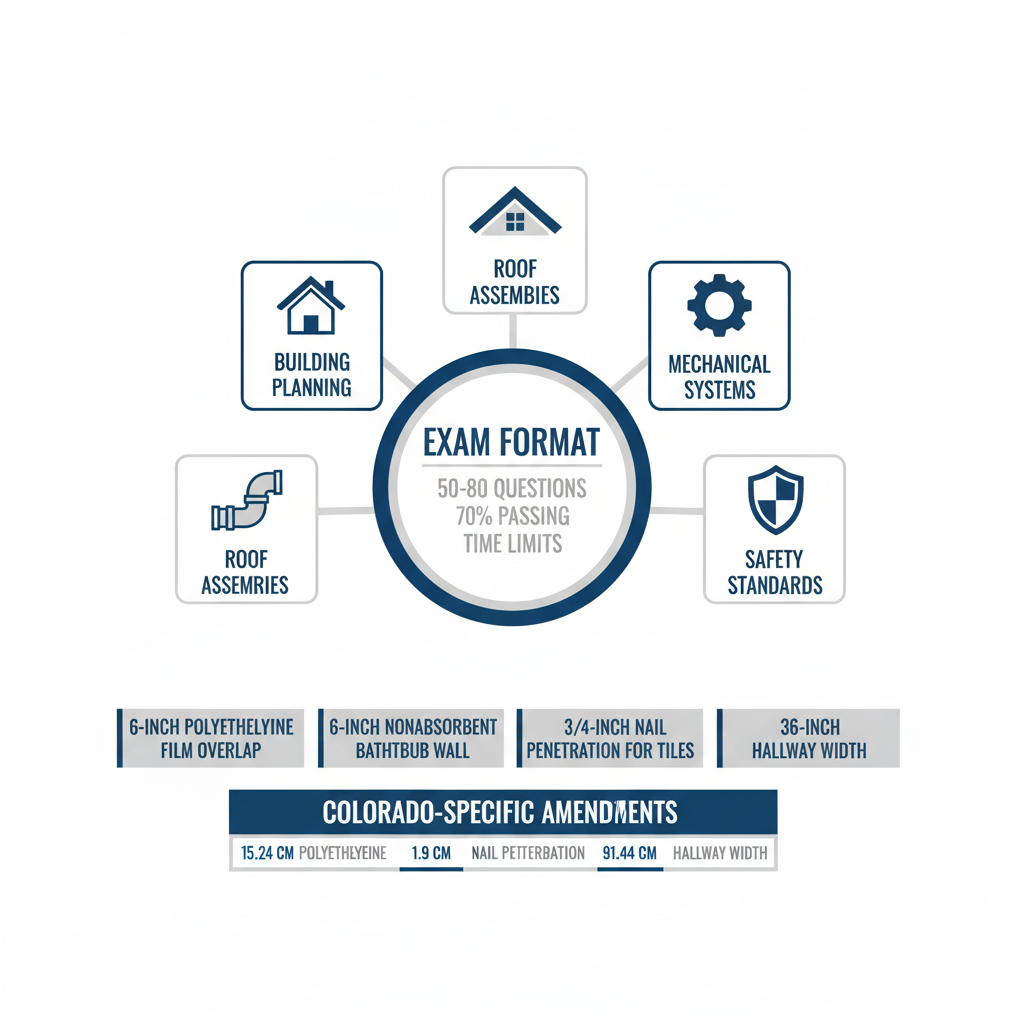
Breakdown of Colorado residential contractor licensing exam structure and standards
This visual overview highlights the interconnected topics, helping aspirants prioritize study efforts effectively. Moving from structure to specifics, understanding these standards directly impacts exam success and on-site decision-making.
Key Technical Standards Covered
Delving deeper into IRC exam preparation for contractors, the test emphasizes precise code requirements that promote safety and durability. Key technical standards include moisture control, where joints in polyethylene film vapor retarders must overlap a minimum of 6 inches to prevent condensation issues (IRC R702.7). Similarly, nonabsorbent wall surfaces are required to extend at least 6 inches above bathtubs to mitigate water damage in wet areas (IRC R307.1).
Roofing details are crucial, with nails fastening concrete tiles needing to penetrate 3/4 inch into the deck or fully through it for secure attachment against wind uplift (IRC R905.11.4.3). Hallway dimensions ensure accessibility, mandating a minimum width of 36 inches in residential settings to accommodate safe egress (IRC R311.6, Table R303.5.1).
Colorado-Specific Amendments
While the national IRC forms the backbone, the Colorado contractor license exam incorporates state amendments tailored to regional challenges like high altitudes and variable climates. For the Colorado residential licensing assessment, amendments modify standards in areas such as seismic design and snow load calculations, often referencing local tables in IRC R301.2 for enhanced structural integrity.
Key variations include stricter radon mitigation in basements and adjustments to ventilation rates for energy conservation, as outlined by the Colorado Department of Regulatory Agencies. These build on national codes by integrating state-specific energy efficiency mandates, ensuring homes withstand Colorado’s unique weather patterns.
We integrate these amendments seamlessly in our general contractor exam prep general contractor exam prep courses, blending them with IRC fundamentals. This approach equips contractors to navigate both national and local requirements, ultimately leading to smoother licensing and more reliable project outcomes in the state.
Benefits of Effective Exam Preparation
Effective preparation for the residential contractor test prep equips professionals in Colorado with the knowledge needed to excel in licensing exams and build lasting careers. Our members at Contractors of Colorado often share how dedicated study transforms challenges into opportunities, fostering growth within Colorado’s trusted construction community. By mastering exam content, contractors unlock doors to enhanced credibility and project success.
Professional Credibility and Opportunities
Passing the Colorado contractor license exam through residential contractor test prep significantly boosts professional reputation. Achieving the required 70% passing score demonstrates expertise, making contractors stand out in competitive markets. Clients trust verified professionals more, leading to repeat business and referrals.
Access to state projects becomes a key advantage, as licensure qualifies individuals for bids on residential developments across the state. For instance, our verified network connects members to high-value opportunities, streamlining project discovery. Networking via industry events and directories further amplifies this, allowing contractors to collaborate and secure leads efficiently.
- Enhanced visibility in Colorado’s Trusted Construction Community
- Streamlined access to homeowner projects through our membership directory
- Increased client confidence from proven certification
These elements position contractors for sustained success, as seen in testimonials from members who doubled their project intake post-licensure.
Compliance and Safety Advantages
Thorough ICC residential contractor exam prep ensures deep understanding of building codes, directly reducing risks in residential construction. Knowledge of standards like those in IRC Chapter 27 promotes safer installations, such as plumbing fixtures that meet quality and performance requirements. For example, Section R2701 mandates smooth, impervious surfaces free from defects, preventing hazards like leaks or contamination.
Contractors familiar with these codes install fixtures correctly, adhering to specifications for materials like enameled cast-iron or stainless steel, as outlined in Table P2701.1. This includes ASME standards for air gap fittings and hydraulic performance, ensuring reliable water systems. Such compliance minimizes liabilities, avoiding costly rework or legal issues.
The advantages of IRC exam readiness extend to overall site safety, with proper fixture spacing and secure mounting per Section P2705 reducing accidents. Benefits of Colorado contractor certification training include fewer delays from inspections, fostering efficient workflows. Hypothetically, a contractor ignoring bathtub wall height standards risks structural failures, but prepared professionals deliver durable, safe homes.
- Lower rework costs through proactive code adherence
- Improved worker and occupant safety via standard-compliant practices
- Reduced insurance premiums from demonstrated risk management
Long-Term Career Growth
Beyond initial licensure, effective exam preparation lays the foundation for career advancement within our network. Our members experience progression from specialty work to general contracting, leveraging education resources for ongoing development. This path opens doors to leadership roles and expanded services.
Membership perks at Contractors of Colorado provide exclusive access to professional development, including advanced training and business planning support. Events facilitate connections with mentors and peers, accelerating growth. For example, small business lending referrals help scale operations, while marketing services enhance visibility.
Sustained benefits include reduced retake fees and delays, allowing focus on innovation. As one member noted, “Our prep courses turned my solo operation into a thriving firm.” These resources ensure long-term viability in Colorado’s dynamic construction landscape.
- Access to industry events for networking and skill-building
- Professional services program for accounting and technology support
- Verified status driving consistent lead generation
How Residential Contractor Exam Preparation Works
Effective residential contractor test prep in Colorado begins with a structured approach that aligns with state licensing requirements. We guide members through this process at Contractors of Colorado, emphasizing practical steps to master the International Residential Code (IRC) and achieve certification. This preparation builds the knowledge needed for the exam’s technical demands, from structural elements to code compliance.
Study Methods and Resources
Residential contractor test prep in Colorado relies on proven techniques to cover IRC essentials. Start by assessing your knowledge gaps through self-evaluations or diagnostic quizzes offered by ICC resources. We recommend selecting targeted materials like official ICC study guides, which detail code sections relevant to Colorado’s building standards.
Key resources include comprehensive online courses that break down complex topics into digestible modules. For instance, online general contractor prep provides interactive lessons tailored to residential exam content, featuring video explanations and quizzes. Practice exams simulate the real test environment, helping you aim for the 70% passing threshold. Supplement with printed guides for in-depth review of chapters like roofing and foundations. When choosing resources, prioritize those endorsed by ICC for accuracy, ensuring they address Colorado-specific amendments. This structured prep for residential exams in Colorado combines self-study with guided learning for optimal retention.
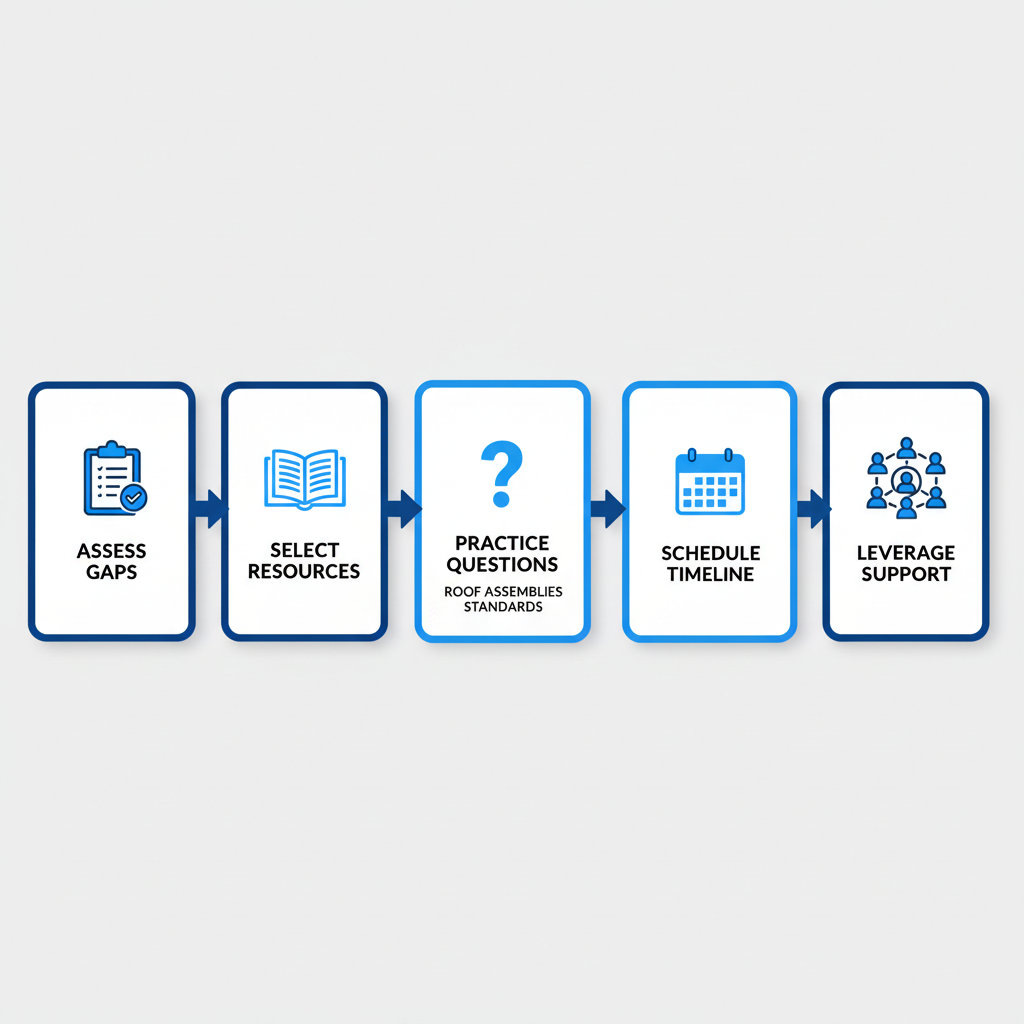
Step-by-step residential contractor exam preparation process
The diagram above outlines the overall workflow, reinforcing how these methods interconnect to streamline your efforts.
Practice with Sample Questions
Mastering technical topics requires hands-on application through sample questions. Begin by reviewing practice sets focused on high-yield areas like roofing and foundations, sourcing them from ICC publications or approved prep platforms. Strategies include timed sessions to build stamina and detailed answer reviews to understand code rationale.
For example, consider a roofing question: “What is the minimum nail penetration required for asphalt shingles per IRC?” The correct answer draws from Section R905, specifying at least 3/4 inch into the deck for secure fastening, preventing uplift in Colorado’s variable weather. Walk through this by identifying the code reference, applying it to a scenario like a sloped roof installation, and noting exceptions for high-wind zones.
Another sample: “How must roof flashings be installed to ensure weather protection?” Reference R903 requires corrosion-resistant materials at valleys and penetrations, with overlaps to deflect moisture. Practice by diagramming installations, then test variations for foundations, such as footing depth requirements under R403. A third example involves photovoltaic integrations per R907, ensuring compliance with NFPA 70. This practical training for contractor certification transforms theory into exam-ready skills. Avoid cramming; instead, space sessions over weeks for better comprehension.
Timeline and Scheduling
We advise an 8-12 week timeline for the Colorado contractor license exam, allowing time to cover all topics without overload. Dedicate the first 4 weeks to foundational review using ICC residential contractor exam prep materials, focusing on code chapters like Chapter 9 for roof assemblies. Weeks 5-8 shift to intensive practice exams, tracking progress toward 70% accuracy.
In the final 4 weeks, refine weak areas and simulate full tests under timed conditions. Integrate our programs at Contractors of Colorado for efficiency; our classes in the state offer weekly sessions that align with this schedule, providing expert feedback and peer discussions. For those balancing work, opt for flexible online modules to fit evenings or weekends. This approach answers how long you should study for the ICC residential contractor exam, preventing burnout while ensuring thorough preparation. By following this plan, members join Colorado’s Trusted Construction Community equipped for success.
Best Practices for Residential Contractor Exam Success
Preparing for the residential contractor test requires a structured approach that builds confidence and competence. We have guided countless members through this process at Contractors of Colorado, emphasizing consistent habits that align with Colorado’s rigorous standards. By adopting these best practices, aspiring contractors can enhance their mastery of the International Residential Code (IRC) and state-specific amendments, paving the way for successful licensing.
Daily Study Routines and Techniques
Effective residential contractor test prep in Colorado begins with disciplined daily routines that target retention and application. We advise our members to dedicate 1-2 hours each day to weak areas, such as structural framing or electrical systems, using techniques like spaced repetition to reinforce IRC details over time.
Incorporate ICC residential contractor exam prep methods, including active recall through flashcards for code sections and optimal strategies for Colorado contractor exams via practice quizzes. For instance, one of our past students, a journeyman carpenter, transformed his scores by reviewing 20 code provisions daily, focusing on ventilation and insulation chapters. This approach not only builds knowledge but also sharpens test-taking skills.
To prevent burnout, balance study with short breaks and real-world application, like reviewing job site photos. Practice under timed conditions, as recommended by ICC Exam Study Tips, to simulate exam pressure and improve speed. Implement this by creating a weekly log to track progress, ensuring steady advancement toward exam day.
Avoiding Common Pitfalls
Many candidates stumble during the Colorado contractor license exam by underestimating its technical depth or overlooking key areas. Common mistakes include neglecting state amendments to the IRC, such as those for energy efficiency in high-altitude regions, or ignoring specialized chapters on plumbing and roofing systems that carry significant weight.
Another frequent error is cramming sporadically rather than building consistent knowledge, leading to gaps in understanding load-bearing calculations or fire safety protocols. We have seen members fail initially by skipping hands-on practice, assuming rote memorization suffices for scenario-based questions.
To avoid these, conduct regular self-assessments:
- Review all IRC chapters weekly, prioritizing Colorado-specific updates.
- Simulate full exams monthly to identify blind spots.
- Consult verified resources early to clarify complex topics like seismic design.
By addressing these pitfalls proactively, you can develop advanced prep tips for residential licensing that foster a comprehensive grasp, reducing anxiety and boosting pass rates.
Leveraging Support Networks
At Contractors of Colorado, we emphasize the power of community in exam preparation, offering access to events and classes that connect you with experienced peers. Joining our network provides advanced prep tips for residential licensing through structured contractor license classes, where instructors break down tricky code interpretations.
The benefits are clear: group study sessions during our industry events allow for peer advice on real exam challenges, like navigating electrical permitting rules. One member credited our monthly meetups for clarifying roofing code variances, turning potential pitfalls into strengths.
Take these action steps:
- Enroll in our contractor license classes for guided review.
- Attend networking events to form study groups.
- Seek mentorship from verified members for personalized feedback.
This collaborative approach not only accelerates learning but also builds lasting professional ties, ensuring long-term success in Colorado’s construction community.
Achieving Licensing Success in Colorado
As we conclude this guide on residential contractor test prep in Colorado, reflect on the foundational strategies we’ve explored. Mastering the Colorado contractor license exam demands a deep understanding of building codes, such as the minima outlined in IRC 2021 Chapter 3 for barriers, dimensions, and structural planning. From dissecting exam mechanics to practicing with targeted scenarios, thorough preparation ensures you not only pass but excel in applying these standards to real-world projects. Benefits like enhanced credibility and access to premium opportunities underscore the value of this investment.
Key takeaways emphasize consistent study routines, leveraging code references for load resistance and climatic criteria, and honing skills through simulated tests. At Contractors of Colorado, our education programs and networking events provide the support needed for the path to Colorado residential certification. These resources transform knowledge into actionable expertise, fostering compliance and innovation in your work.
We invite you to take the next step: enroll in our ICC residential contractor exam prep classes and join our directory today. Explore construction license exam prep construction license exam prep tailored for Colorado’s unique requirements. As Colorado’s Trusted Construction Community, we connect homeowners and professionals with trusted contractors like you.
This culmination of exam readiness training paves the way for a thriving, compliant career in residential contracting across the state, building safer communities one project at a time.