
Contractor License Classes
Table of Contents
Essential Guide to Contractor License Classes in Colorado
Navigating the world of construction in Colorado starts with understanding contractor license classes. These classifications are essential for professionals to operate legally, meet safety standards, and build trust with homeowners. At Contractors of Colorado, we connect homeowners and professionals with trusted contractors by emphasizing verified expertise through licensing education programs. Whether you’re a Denver remodeler tackling a kitchen upgrade or a statewide builder, grasping these classes ensures compliance and success.
Colorado’s licensing system is decentralized, meaning requirements vary by municipality rather than a uniform statewide mandate. For instance, classifications like residential, builder, and general contractor licenses address specific scopes of work, with some cities requiring the ICC general contractor exam for advanced projects. Local rules, such as those in Arapahoe County, demand proof of insurance, paperwork, and experience–often substituted by technical training or contractor certification training. We at Contractors of Colorado help verify these details, answering key questions like what classifications exist and how to check city-specific Colorado general contractor license requirements in your area.This guide equips you with foundational knowledge to thrive in Colorado’s construction landscape. Ahead, explore detailed breakdowns of classifications and preparation strategies to elevate your projects.
Key Concepts in Contractor Licensing
In Colorado, contractor licensing forms the backbone of safe and compliant construction practices. As a trusted platform, we at Contractors of Colorado verify these licenses to connect homeowners with reliable professionals. Understanding key concepts like classifications and requirements ensures aspiring contractors navigate the process effectively. This knowledge highlights the importance of proper credentials in our state’s diverse municipal systems.
License Classifications Explained
Contractor license classes in Colorado primarily fall into residential, builder, and general categories, each defining specific scopes of work. Residential licenses focus on home repairs and renovations under $50,000, akin to a home fixer handling interior updates or minor additions. Builder licenses permit new construction up to certain value limits, such as single-family homes, while general contractor licenses cover commercial projects and larger-scale endeavors exceeding those thresholds.
In Colorado, licensing categories vary by municipality since there is no statewide mandate. For instance, the City of Longmont outlines Class C licenses for one- and two-family dwellings, aligning with residential scopes, while Class A general licenses allow work on most buildings except specialized trades. These certification levels, drawn from official municipal guidelines, emphasize compliance with local building codes. We recommend verifying classifications through our platform to match project needs accurately.
Transitioning to requirements, note that meeting these basics paves the way for educational pursuits that strengthen applications.
Experience and Education Requirements
Colorado general contractor license requirements typically demand four years of verifiable work experience, though this varies by city–Denver may require additional documentation compared to smaller locales. Experience must demonstrate hands-on involvement in construction tasks, from planning to execution, ensuring candidates grasp practical challenges.
Technical training can substitute for part of the experience, offering partial credit through programs like vocational courses or apprenticeships. The icc general contractor exam ties into these by testing knowledge across classifications, often integrated into municipal approvals. In Longmont, for example, trade-specific licenses require state registration for plumbing alongside local experience proofs. Insurance is crucial too: general liability coverage of at least $1 million and workers’ compensation are standard to protect against job-site risks.
Our verification services review these elements thoroughly, helping members meet colorado general contractor license requirements efficiently. Consider how education builds on experience for smoother exam preparation.
Differences Between License Types
Residential licenses limit scope to smaller home projects under $50,000, excluding large commercial builds, while builder licenses extend to new residential construction but not unlimited commercial work. General contractor licenses encompass both, serving as full project leads for complex endeavors like office developments or multi-unit structures.
In Colorado contexts, residential suits individual homeowners, builders target housing developments, and generals handle broad commercial scopes–Denver’s rules, for instance, differentiate by project value and complexity more stringently than statewide norms. The icc general contractor exam often applies to higher general levels, validating broader expertise. Municipal variations, as in Longmont’s Class B excluding certain building types, underscore these distinctions for safety and code adherence.
Grasping these differences empowers informed choices; our general contractor license exam prep supports navigation of such nuances.
The following table summarizes key contrasts:
| Type | Scope | Experience Needed | Insurance Min |
|---|---|---|---|
| Residential | Home repairs/renovations under $50k | 2-4 years | $500k liability, workers’ comp |
| Builder | New residential construction up to limits | 4 years | $1M liability, workers’ comp |
| General | Commercial/large projects over limits | 4+ years | $1M+ liability, workers’ comp |
This comparison illustrates how scopes escalate with experience and insurance demands, aiding decisions based on project scale. For residential work, lower barriers allow quicker entry, yet generals benefit from expansive opportunities in Colorado’s growing market. Understanding these layers not only complies with regulations but also enhances professional credibility through verified pathways like ours. As we connect homeowners and professionals with trusted contractors, mastering these concepts leads to tangible benefits in career advancement and project success.
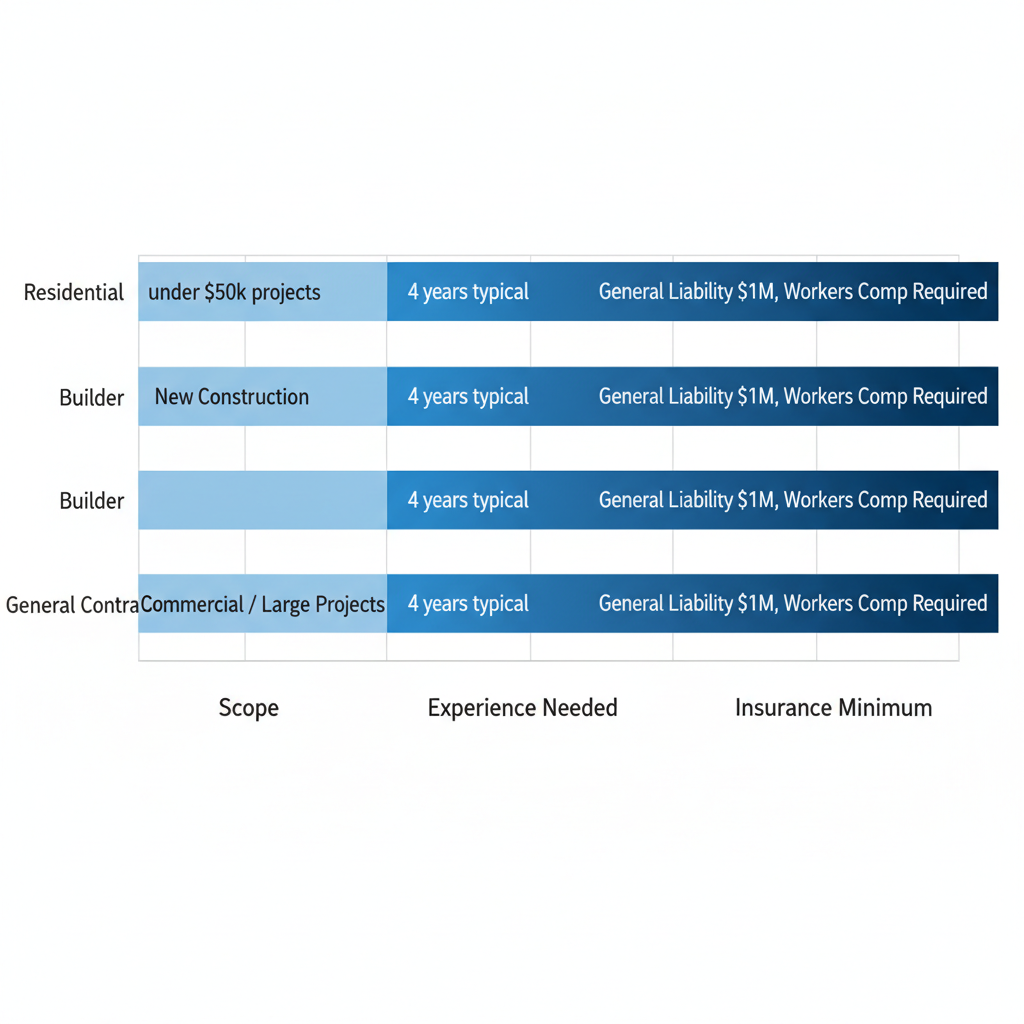
Comparison of key contractor license types in Colorado
Visual aids like this chart reinforce the practical implications, showing how insurance scales with scope to mitigate risks effectively. In our experience verifying thousands of members, aligning license type with project demands prevents common pitfalls and fosters long-term trust in Colorado’s construction community.
Benefits of Contractor License Classes
Enrolling in contractor education programs offers transformative advantages for professionals seeking to elevate their careers in the construction industry. These classes not only equip you with essential knowledge but also position you within Colorado’s trusted construction community. As part of our membership-driven platform, we support contractors through verified training that aligns with state standards, ensuring long-term success.
Professional Credibility and Opportunities
Contractor license classes in Colorado immediately boost your professional standing, fostering trust among clients and peers. By demonstrating verified knowledge through structured education, you signal reliability, which is crucial in an industry where reputation drives referrals. For instance, a contractor who completed our GC Exam Prep course shared, “After finishing the classes, clients viewed me as a credible partner, leading to repeat business and higher-value projects.”
This credibility opens doors to larger opportunities, such as bidding on commercial contracts that require licensed professionals. In competitive markets, certification advantages distinguish you from unlicensed competitors, allowing access to premium listings in directories like ours. We connect homeowners and professionals with trusted contractors, and our verified members often secure projects that self-taught individuals miss.
In Colorado, where municipalities enforce strict licensing, these classes align with local verification processes, like those in Arapahoe County. This compliance builds a foundation for sustained growth, helping you navigate the state’s diverse project landscape with confidence.
Skill Development and Compliance
Investing in training benefits for contractors sharpens your expertise in critical areas, from building codes to safety protocols, ensuring you meet evolving standards. Classes substitute for hands-on experience, particularly for new entrants, by providing practical insights through simulations and case studies. One member testified, “The course on project management turned my theoretical knowledge into actionable skills, preventing costly errors on my first major job.”
Education ensures adherence to colorado general contractor license requirements, including the icc general contractor exam, which many municipalities mandate. By covering topics like insurance obligations and permitting, these programs help avoid fines–up to thousands of dollars in penalties for non-compliance, as outlined in county guidelines. Self-study might cover basics, but classes offer structured guidance; here’s a quick pros/cons comparison:
- Pros of classes vs. self-study: Interactive learning with expert instructors, access to updated materials on recent code changes, and peer discussions for real-world application.
- Cons of classes vs. self-study: Higher upfront cost and scheduled commitments, though the investment yields faster certification and fewer exam retakes.
For Colorado contractors, this education ties directly to local regulations, such as Arapahoe County’s verification of licenses and insurance, empowering you to operate compliantly across cities like Denver.
Networking Through Education Programs
Certification advantages extend beyond skills to invaluable connections formed during classes and related events. Engaging with instructors and fellow students creates a support network, sparking collaborations on future projects. A participant noted, “Networking at the sessions introduced me to suppliers and partners, expanding my reach in the Colorado market.”
Our platform hosts industry events that complement classroom learning, facilitating introductions within Colorado’s trusted construction community. These interactions often lead to mentorships, joint bids, and referrals through our 24K+ members, enhancing visibility in the directory.
In Colorado, where local requirements vary by city–such as checking municipal licensing needs–these networks provide insights into regional nuances. We support members through these programs, ensuring you build lasting relationships that drive business growth and project opportunities statewide.
How Contractor Licensing Works
Obtaining a contractor license in Colorado involves a structured process that ensures professionals meet safety and competency standards. We at Contractors of Colorado guide members through these steps, verifying documentation to connect homeowners with reliable experts. This section breaks down the key phases, from application to renewal, helping you navigate the requirements efficiently.
Application and Exam Processes
To start the licensing journey, contractors must submit an application to the relevant state or local authority, including proof of experience, such as years in the trade or completed projects. Fees typically range from $100 to $500, depending on the license class, and paperwork requires details on business structure and references. Processing times often span 2-4 weeks, during which officials review qualifications.
Next, many applicants prepare for the icc general contractor exam, a critical component for general contracting roles. This exam covers building codes, safety protocols, and business practices, with topics like structural systems, electrical basics, and project management. To pass, candidates need a score of 70-75%, testing comprehensive knowledge. For preparation, consider an online general contractor license course tailored to Colorado standards. In Colorado, contractor license classes in Colorado often incorporate these exam protocols, blending classroom instruction with practice tests to build confidence.
We recommend scheduling the exam through approved testing centers, allowing 4-6 weeks for study. A key tip: Focus on code updates, as they frequently appear on the test, ensuring you’re ready for real-world applications.
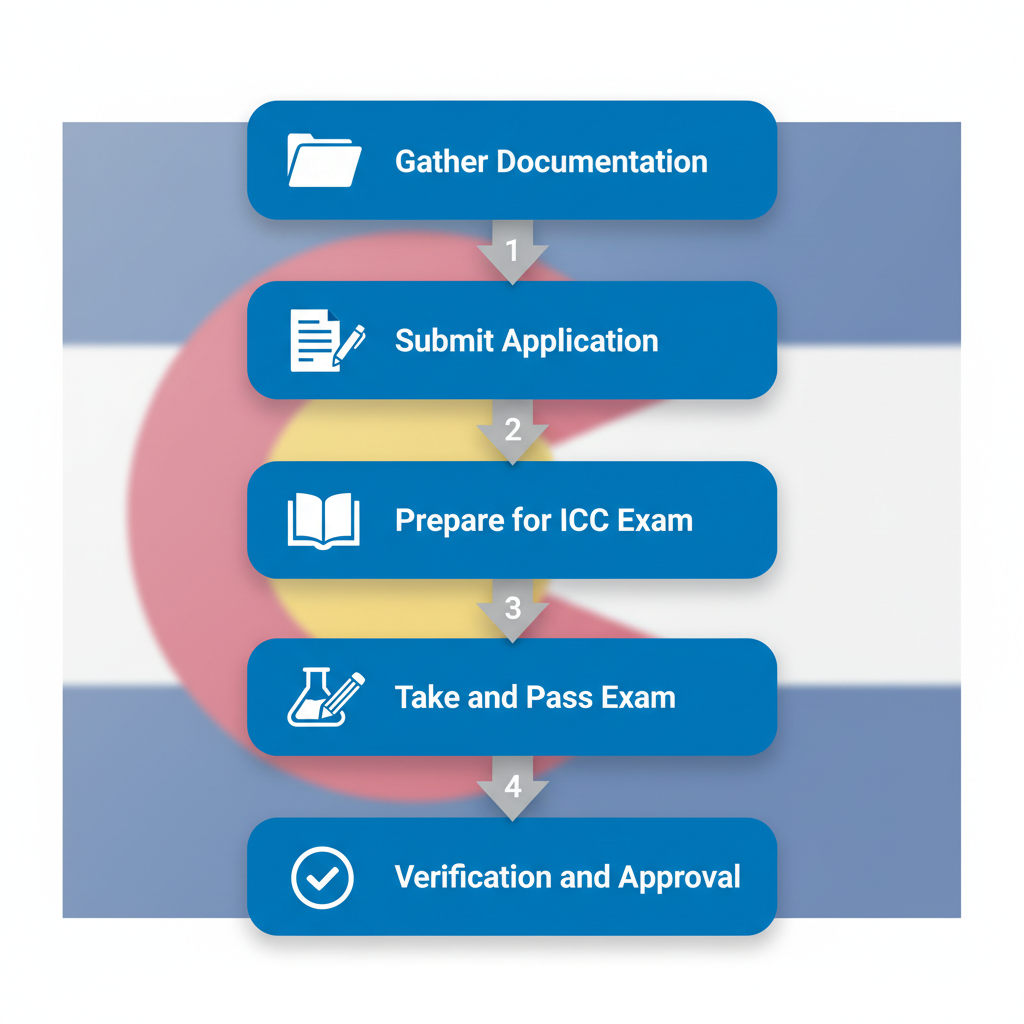
Step-by-step contractor licensing process in Colorado
In practice, this structured approach demystifies entry into the field. By mastering these steps, aspiring contractors position themselves for success in Colorado’s competitive market, where verified credentials open doors to more projects.
City-Specific Requirements in Colorado
Colorado’s licensing procedures vary by municipality, reflecting local building codes and oversight needs. For instance, colorado general contractor license requirements in Denver mandate a business license plus proof of competency through exams for projects over certain thresholds. Applications involve zoning checks and site-specific compliance, with approvals taking up to 30 days.
In Longmont, as outlined in city guidelines, contractors select from classes like Class A for broad building work or Class D specialties such as roofing and masonry. Trade-specific licenses cover mechanical and electrical tasks, requiring state registration for plumbing. These rules ensure adherence to safety standards, preventing unqualified work on residential or commercial sites.
Aurora follows similar patterns, emphasizing insurance and bond postings, while statewide options apply to inter-city projects without local exams in some cases.
The following table compares key variations across major areas:
| City | License Needed | Exam Req | Insurance |
|---|---|---|---|
| Denver | General Contractor License | ICC Exam Required | Liability & Workers’ Comp |
| Longmont | Class A/B/C or Specialty | Local Exam Option | Minimum $300K Coverage |
| Aurora | Business & Trade License | Competency Test | Proof of General Liability |
| Statewide | State Registration | Varies by Trade | Bond if Applicable |
This comparison highlights how Denver’s stringent icc general contractor exam demands contrast with Longmont’s flexible specialties. We verify these details for our members, streamlining compliance. A practical tip: Consult city websites early to avoid delays in multi-location work.
Understanding these differences empowers contractors to target suitable markets. For example, starting in Longmont allows testing Class C limits before scaling to Denver’s broader scopes, aligning with project goals.
Verification and Renewal Steps
Once licensed, verification involves background checks through fingerprinting and criminal history reviews, often conducted by state agencies. Proof of insurance, including general liability and workers’ compensation, must be current, with minimums like $1 million coverage. We at Contractors of Colorado include these checks in our verification services, confirming legitimacy for directory listings.
Renewal occurs every 1-3 years, depending on the license type; for instance, general contractor renewals require 6-12 hours of continuing education units (CEUs) on topics like code changes and safety. Submit renewal forms online or by mail, paying fees around $200, with processing in 2-4 weeks. Missing deadlines can lead to lapsed status and fines.
To stay compliant:
- Track expiration dates via calendar reminders.
- Complete CEUs through approved providers.
- Update insurance proofs annually.
These steps maintain professional standing. In Colorado, proactive renewal ties into ongoing education, much like initial exam protocols, fostering a cycle of improvement. Our platform supports this by offering resources and reminders, ensuring members remain project-ready without interruptions.
Best Practices for License Preparation
Preparing for your contractor license in Colorado requires a strategic approach that combines dedicated study, practical experience, and community support. As part of Colorado’s Trusted Construction Community, we emphasize proven methods to help you succeed. These best practices will guide you through the preparation process, addressing common challenges and boosting your confidence for exams and beyond.
Effective Exam Study Strategies
We recommend developing a structured study plan to tackle the demands of exams like the construction license exam prep. Start with an 8-12 week timeline, allocating daily sessions of 1-2 hours to build retention without burnout. Focus on key topics such as building codes, safety regulations, and project management, which are staples in the icc general contractor exam.
Incorporate active learning techniques for optimal results. Use flashcards for quick reviews of terminology and formulas, and practice with mock exams to simulate test conditions–these can help you aim for the typical passing score of 70%. Avoid pitfalls like cramming, which leads to short-term memory loss; instead, review weekly to reinforce concepts. For contractor license classes in Colorado, enroll in our prep courses that include guided sessions and real-world scenarios.
Apply these strategies locally by aligning your study with state-specific codes. Sample schedule: Week 1-4 on theory, Week 5-8 on practice tests, and Week 9-12 on weak areas. Key takeaways: Consistent practice raises success rates by up to 40%, per industry standards. Leverage guides from official sources to cover exam topics like blueprint reading and estimating.
Building Experience and Compliance
Gaining qualifying experience is foundational to meeting colorado general contractor license requirements. We advise starting with apprenticeships or entry-level roles under licensed mentors to log the required hours–typically 4,000 for general contracting in many jurisdictions. Track your progress meticulously using digital logs or journals, noting projects, durations, and skills acquired.
To substitute for some experience, technical training or education programs can count toward up to 25% of requirements, but verify with local boards. For ongoing compliance, maintain CEU records for renewals, aiming for 12 hours annually. Common pitfalls include incomplete documentation; always use official forms to avoid delays. In Colorado, early application ensures timely processing–submit 30-60 days before your target start date.Drawing from Arapahoe County Contractor Licensing guidelines, utilize their checklists for verifications and renewals to stay compliant. This proactive approach not only fulfills prerequisites but also prepares you for ethical practices on the job. Key takeaways: Documented experience builds credibility, and we support members through verification services to streamline this process.
Leveraging Resources and Networks
Tap into education programs and events to enhance your certification strategies. We offer comprehensive training like GC Exam Prep and Construction 101, designed for Colorado’s unique regulatory landscape. These resources provide expert-led sessions on prep techniques, including topic breakdowns for the icc general contractor exam.
Join industry events for networking–our platform hosts mixers and workshops that connect you with peers and mentors. Register as a contractor in Colorado by first completing education, then applying through the state portal; we guide members with step-by-step support. Pitfalls to avoid: Isolating your prep–collaboration accelerates learning by sharing insights on passing scores and exam topics.
In practice, attend local events to discuss experiences and access exclusive resources. For how to register, start with verification of your background and insurance. Key takeaways: Our network of 24K+ members fosters growth, turning preparation into a community-driven success. By leveraging these, you’ll not only pass but thrive in Colorado’s construction scene.
Navigating Your Path to Licensing Success
Navigating contractor license classes in Colorado requires understanding the diverse classifications, from Class A general contractor licenses that cover broad building projects to specialized trade licenses for electrical, plumbing, and mechanical work. As outlined by the City of Longmont’s guidelines, requirements vary by locality, including Class B for medium-scale constructions and Class C for residential dwellings, alongside specialty Class D options like roofing and masonry. We at Contractors of Colorado emphasize these colorado general contractor license requirements to help you avoid compliance pitfalls and streamline your certification journeys.
Preparing effectively for the icc general contractor exam through targeted education maximizes success, revealing local variations that statewide licensing does not fully mandate. Our platform highlights how thorough preparation fosters networking opportunities and ensures adherence to building codes, turning potential challenges into smooth licensing pathways.
Join us today by enrolling in our contractor license school or becoming a member to access verified resources, exam prep classes, and industry events and exclusive benefits. Whether seeking substitutes for traditional processes or full guidance, we provide comprehensive support to elevate your professional standing in Colorado’s trusted construction community.